
Vulnerability Assessment vs Penetration Testing: Key Differences
Vulnerability assessment vs penetration testing compared by goal, depth, frequency, cost and output, plus PCI DSS 11.3 and 11.4 and where red teaming fits.
By NetGuardUpdated: 7 min readنسخه فارسی
The difference between a vulnerability assessment and a penetration test fits in one sentence. A vulnerability assessment asks "what known weaknesses exist across all our assets?", while a penetration test asks "how far could a real attacker get with them?". The first is broad, automated and frequent; the second is deep, human-driven and periodic.
Many organizations use the terms interchangeably, and the result is either wasted budget or a security gap. A scan report will not pass as a penetration test with an auditor, and an annual penetration test cannot replace continuous vulnerability monitoring. This article compares vulnerability assessment vs penetration testing by definition, goal, depth, frequency, cost and output, and explains when each is required.
What is a vulnerability assessment?
A vulnerability assessment identifies, classifies and prioritizes known weaknesses in servers, endpoints, network devices, databases and web applications. Its main tool is a vulnerability scanner, which compares software versions and configurations against CVE data and secure configuration rules.
Key characteristics:
- Breadth over depth: the aim is to cover every asset, not to dig deeply into one system.
- Automated and repeatable: it runs on a schedule without a specialist present for every cycle.
- No exploitation: weaknesses are detected but normally not exploited.
- Part of a cycle: its output feeds the vulnerability management lifecycle and patching.
What is penetration testing?
A penetration test is an authorized, controlled attack within an agreed scope. A tester behaves like a real adversary: finding weaknesses, exploiting them, chaining small issues together and showing how sensitive data or systems could be reached. Automated tools are used, but the real value lies in human creativity and judgment.
Types of penetration tests
- By prior knowledge: black box (no information), grey box (some information or a low-privilege account) and white box (documentation and source code access).
- By target: external (internet-facing assets), internal (assuming an initial foothold), web application and API, wireless, and social engineering.
Before any test, define the scope, rules of engagement, schedule, points of contact and written authorization.
Vulnerability assessment vs penetration testing at a glance
| Criterion | Vulnerability assessment | Penetration testing |
|---|---|---|
| Goal | Find as many known weaknesses as possible | Prove exploitability and real impact |
| Depth | Shallow to moderate, broad | Deep, focused on a defined scope |
| Automation | Mostly automated | Mostly manual, tool-assisted |
| Frequency | Monthly, quarterly or continuous | At least annually and after major changes |
| Duration | Hours per cycle | Days to weeks |
| Cost | Low per cycle | High per engagement |
| Skills | Running tools, analyzing results | Offensive expertise and experience |
| Output | Prioritized findings with fixes | Attack paths, evidence, strategic advice |
| Unknown issues | Limited to existing checks | Can uncover logic flaws and chained issues |
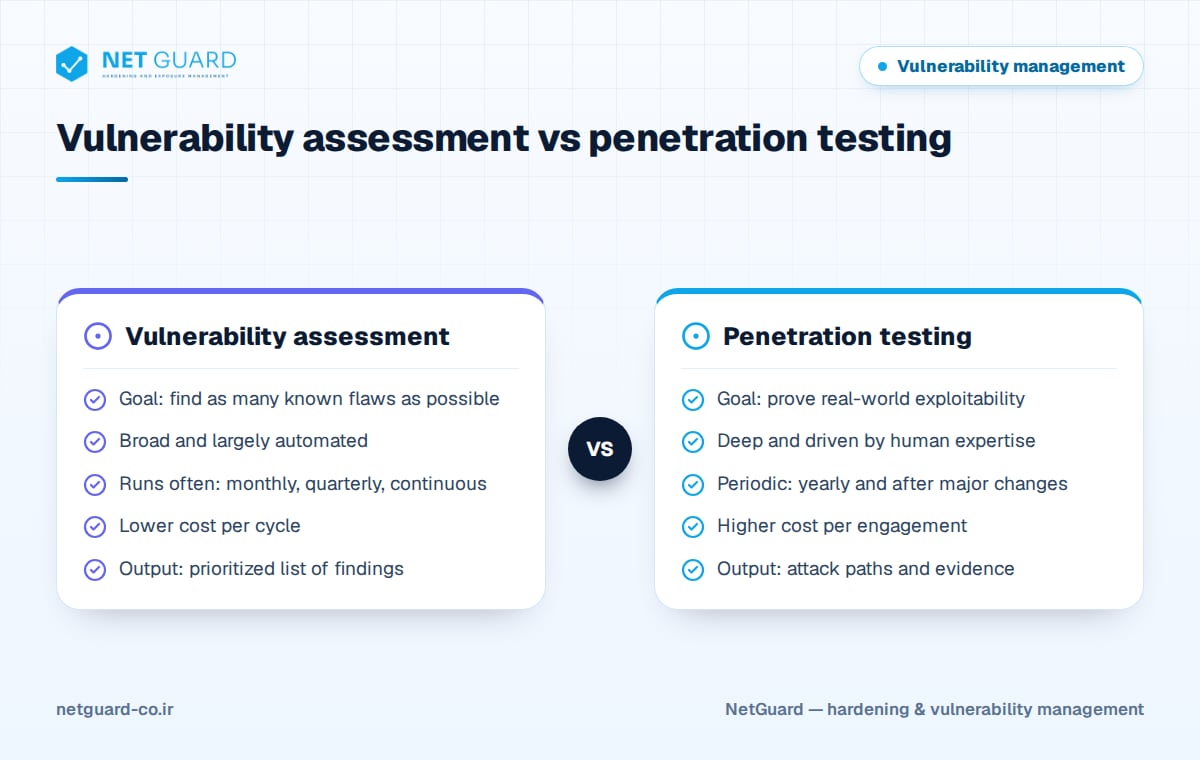
Depth vs breadth
A scanner can assess thousands of systems in hours, but it does not understand that an open file share, a weak password and an over-privileged service account together form a direct path to the domain controller. A penetration tester finds exactly those chains. On the other hand, a penetration test sees only part of the estate during a limited window and gives a point-in-time picture.
Cost and output
Once deployed, each scan cycle is cheap, which is why it can run often. Penetration testing cost depends on scope, complexity, test type and team experience, and is much higher per engagement. An assessment produces an operational to-do list for technical teams; a penetration test produces an attack narrative that helps leadership prioritize security investment and demonstrates real risk.
When is each required?
PCI DSS requirements
PCI DSS v4 requires both activities separately:
- Requirement 11.3.1: internal vulnerability scans at least once every three months; high-risk and critical vulnerabilities must be resolved and confirmed by rescans. Requirement 11.3.1.1 covers managing all other vulnerabilities based on a risk analysis.
- Requirement 11.3.2: external scans at least once every three months by a PCI SSC Approved Scanning Vendor (ASV).
- Requirement 11.4: internal and external penetration testing following a defined methodology, at least once every 12 months and after any significant infrastructure or application upgrade or change.
In PCI DSS, scanning does not replace penetration testing, and vice versa.
Other frameworks and triggers
In ISO/IEC 27001:2022, control 8.8 (management of technical vulnerabilities) requires timely identification and evaluation of vulnerabilities. Regular assessment is the backbone of that control, and penetration tests are commonly used as additional evidence. Beyond compliance, these situations usually justify a penetration test:
- Before launching a new internet-facing application or service.
- After a major architecture change, cloud migration or network merger.
- When your assessment program is mature and you want to validate control effectiveness.
- When a customer, partner or regulator asks for one.
Where red teaming fits
Red teaming goes one step beyond penetration testing. A penetration test tries to find as many weaknesses as possible within a scope; a red team exercise sets a specific objective, such as access to a payment system, and pursues it stealthily using a mix of technical, physical and social engineering techniques. The key question is whether your blue team detects and responds to the attack. Red teaming pays off for organizations that already run regular assessments, penetration tests and security monitoring; otherwise it only produces a list of obvious weaknesses.
How the two complement each other
A mature program links these activities in a cycle:
- Continuous assessment: regular authenticated scans of all assets, risk-based prioritization and remediation.
- Clean up before testing: fix obvious scanner findings first so expensive tester time is not spent on low-hanging fruit.
- Targeted penetration testing: focus on critical assets, attack paths and business logic.
- Turn findings into checks: where possible, convert weaknesses found by testers into automated checks or configuration baselines.
- Verify fixes: rescan or retest to confirm findings are closed.
How NetGuard helps
NetGuard covers the assessment side of this cycle: authenticated and agentless scanning of servers, network devices, endpoints and databases, web application and API scanning, prioritization based on known-exploited vulnerabilities and asset criticality, and rescans to verify fixes. Findings are mapped to PCI DSS, ISO 27001 and NIST, and Persian and English reports help you prepare for audits and clean up before a penetration test. See the compliance page for details.
Frequently asked questions
What is penetration testing?
Penetration testing is an authorized, controlled simulated attack in which a security specialist uses real attacker techniques to break into systems, networks or applications. The goal is to prove that vulnerabilities can be exploited, uncover attack chains and measure their real business impact. The scope, rules of engagement and written authorization must be agreed in detail before testing starts.
Can a vulnerability scan replace a penetration test?
No. Vulnerability scanning provides breadth and continuity, finding known weaknesses across all assets, but it does not exploit them and misses logic flaws and chained attacks. Penetration testing provides depth but only a point-in-time view of a limited scope. Standards such as PCI DSS require both separately, so a sound security program includes both.
How often should penetration testing be done?
The common baseline is at least once a year, and PCI DSS requires internal and external penetration tests at least every 12 months and after any significant infrastructure or application change. For sensitive web applications that change frequently, targeted tests after major releases are a good idea. Between tests, regular vulnerability assessment should continue without interruption.
What affects the cost of a penetration test?
Cost depends on the size and complexity of the scope (number of IP addresses, applications, APIs and user roles), the test type (black, grey or white box), duration, whether a retest is included and the team's experience. Fixing obvious issues with a scanner before the test lets testers spend their time on more valuable findings, so the budget delivers more.
What is the difference between penetration testing and red teaming?
A penetration test tries to find and exploit as many vulnerabilities as possible within a defined scope, and the defending team usually knows about it. A red team exercise pursues a specific objective, operates stealthily and mainly measures the organization's ability to detect and respond to an attack. Red teaming suits organizations whose basic security programs are already mature.
- #vulnerability assessment vs penetration testing
- #penetration testing
- #vulnerability assessment
- #pentest vs vulnerability scan
- #red teaming
- #PCI DSS penetration testing