What Is Security Compliance? Compliance vs Security Guide
What is security compliance and how does it differ from security? A practical guide to ISO 27001, PCI DSS, NIST CSF, continuous compliance and audit evidence.
By NetGuardUpdated: 8 min readنسخه فارسی
Security compliance is the ability of an organization to show that its systems, processes and security controls meet the requirements of a standard, law or industry rule: ISO 27001 for information security management, PCI DSS for payment card data, or national rules for critical infrastructure. The key word is show. Compliance is not only doing the right things; it is proving it with documented, auditable evidence.
Compliance matters for two reasons. Regulators, large customers and partners increasingly make it a condition of doing business. And frameworks give security teams a ready-made structure for deciding what to do first. This guide covers compliance vs security, the main frameworks, continuous compliance instead of a yearly scramble, and how hardening and vulnerability management produce the evidence auditors want.
What is security compliance, and how is it different from security?
Security is about reducing real risk: removing unnecessary services, patching vulnerabilities, restricting access and detecting attacks early. Compliance is about matching those activities to a defined set of requirements and proving it to an auditor. The two overlap heavily, but they are not the same:
- Compliant but insecure: every policy is approved, but a server added after the audit is running unhardened with a critical vulnerability.
- Secure but non-compliant: the technical team does the right things, but nothing documents it, so the audit records findings.
- The goal: real technical controls, with tools that generate evidence automatically as a by-product.
| Security | Compliance | |
|---|---|---|
| Goal | Reduce actual risk | Prove conformance to requirements |
| Driver | Threats and asset value | Standard, law or contract |
| Measured by | Open vulnerabilities, incidents | Audit findings, evidence quality |
| Timeframe | Continuous | Usually periodic |
A simple rule: build security to reduce risk, and make compliance a by-product of it, not the other way round.
The main security compliance frameworks
Most organizations deal with more than one framework, and their technical requirements overlap a lot.
ISO/IEC 27001
The international standard for an information security management system (ISMS) and the most widely held security certification. The 2022 edition has 93 Annex A controls in four themes: organizational, people, physical and technological. Controls such as 8.8 (management of technical vulnerabilities) and 8.9 (configuration management) land directly on the infrastructure team. See our ISO 27001 guide.
PCI DSS
The Payment Card Industry Data Security Standard. Version 4.0 was published in March 2022 and 4.0.1 in June 2024. Its technical requirements are unusually specific: secure configurations (Requirement 2), internal and external vulnerability scans every three months, and penetration testing at least annually. Details are in our PCI DSS 4.0 guide.
NIST CSF 2.0
The NIST Cybersecurity Framework 2.0, released in February 2024, organizes outcomes into six functions: Govern, Identify, Protect, Detect, Respond and Recover. It is voluntary and not certifiable, but it is an excellent common language for maturity assessments and board reporting.
CIS Controls
Eighteen prioritized safeguards (version 8.1) grouped into Implementation Groups IG1 to IG3. They are a practical starting point, and the companion CIS Benchmarks define secure configuration settings for specific operating systems and services.
National and sector rules
Many countries have rules for critical infrastructure and regulated sectors. In Iran, for example, the AFTA center issues security requirements for critical infrastructure covering asset inventory, hardening, vulnerability assessment, patching, logging, access control, incident response and periodic audits (see AFTA requirements). Financial regulators such as central banks also set rules for banks and payment providers. These change over time, so always work from the latest official documents.
Continuous compliance vs the annual audit
In the traditional model, teams spend the weeks before an audit collecting screenshots and patching a few servers, producing a report that reflects a single day. Meanwhile new servers appear, emergency changes alter configurations and new CVEs are published every week.
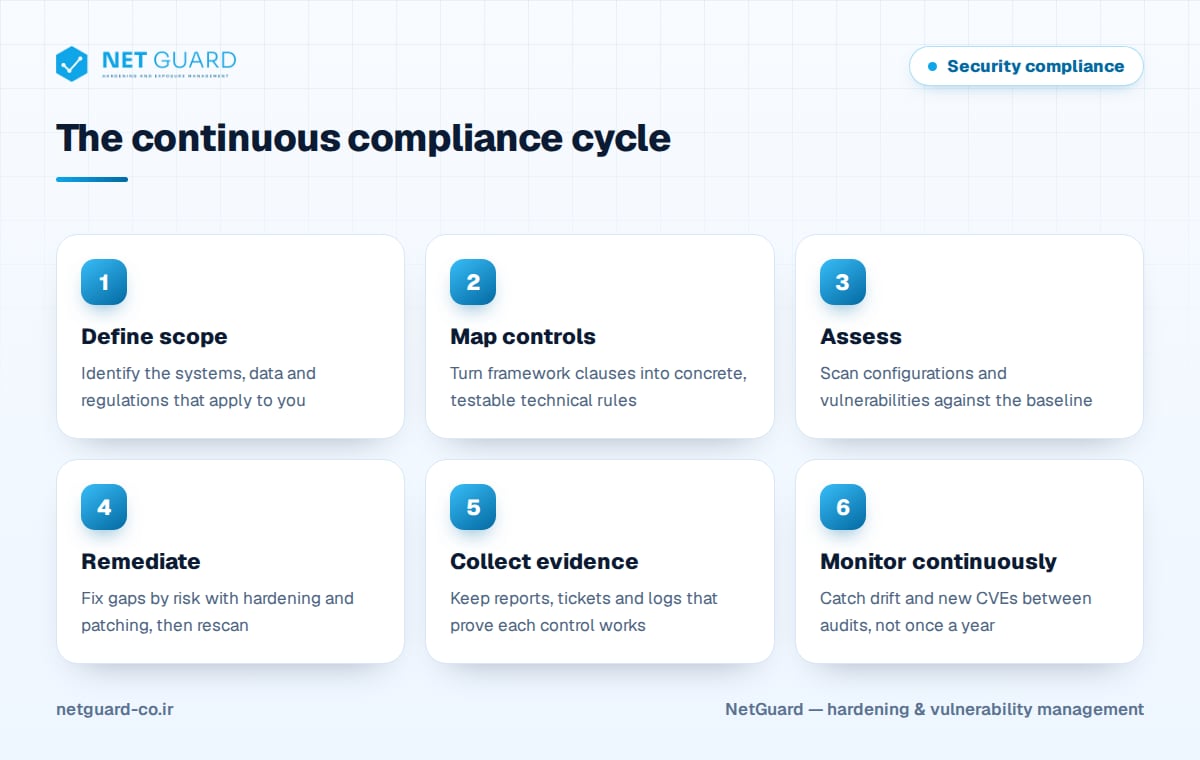
Continuous compliance means controls are measured automatically and constantly, deviations are caught when they happen, and evidence accumulates over the year. Audit day becomes an ordinary working day. The cycle looks like this:
- Define scope: decide which systems, data and business units fall under which requirement. A tight scope cuts cost dramatically.
- Map controls: translate each clause into a testable technical rule, for example "vulnerability management" becomes monthly authenticated scans and a fixed deadline for critical findings.
- Assess: measure the current state with vulnerability scans and configuration audits against your baseline.
- Remediate: prioritize gaps by risk, fix them, and confirm the fix with a rescan.
- Collect evidence: keep dated, traceable reports, tickets and records.
- Monitor continuously: watch for configuration drift and new vulnerabilities between audits.
Audit evidence: what auditors actually ask for
Auditors test two things: whether a control is designed correctly and whether it actually operated throughout the audit period. That usually means three kinds of evidence:
- Design documents: policies, procedures, secure configuration standards, the risk assessment method and, for ISO 27001, the Statement of Applicability (SoA).
- Operating records: periodic scan reports, remediation tickets, change records, access review minutes and logs.
- Technical outputs: real system configurations, benchmark compliance reports and rescan results after remediation.
Good evidence is dated, covers the whole scope, is traceable, and shows the full find, fix, verify loop. Auditors sample servers and months, so evidence must exist for the entire period, not just the last few weeks. Every exception or risk acceptance should be documented and signed off by the risk owner.
How hardening and vulnerability management produce audit evidence
Two technical activities generate most compliance evidence. Hardening defines the secure configuration baseline, and a compliance report against that baseline is direct evidence for configuration controls. Vulnerability management, with regular scanning, prioritization, remediation and rescanning, produces records that nearly every framework requires. Run both on a fixed schedule with the right tooling and much of your evidence builds itself. Our vulnerability management lifecycle article covers the process in depth.
The table below maps frameworks to technical requirements and evidence:
| Framework and clause | Technical requirement | Evidence to show |
|---|---|---|
| ISO 27001 – control 8.8 | Identify and fix technical vulnerabilities in time | Periodic scan reports, tickets, rescans |
| ISO 27001 – control 8.9 | Define and maintain secure configurations | Documented baseline, compliance and drift reports |
| PCI DSS – Requirement 2 | Secure configuration of all system components | Configuration standards, config audit reports |
| PCI DSS – 6.3.3 | Install critical patches within one month | Patch records with release and install dates |
| PCI DSS – 11.3.1 / 11.3.2 | Internal and external (ASV) scans every three months | Quarterly scan and rescan reports |
| NIST CSF 2.0 – Identify | Know assets and their vulnerabilities | Asset inventory, prioritized risk report |
| CIS Controls 4 and 7 | Secure configuration, continuous vuln management | Benchmark scores, vulnerability trends |
| AFTA (general) | Hardening, vulnerability assessment, logging | Assessment reports, remediation records, logs |
One authenticated scan and one configuration audit can satisfy several frameworks at once, so build a single unified control set and map it to each framework instead of running a project per standard.
Common compliance mistakes
- Chasing the certificate: it confirms a past state, not future safety.
- Unclear scope: too wide inflates cost; too narrow fails the audit.
- Manual evidence: undated screenshots carry little weight.
- Undocumented exceptions: unpatchable legacy systems need compensating controls and written risk acceptance.
- Excluding engineers: requirements never reach real system settings.
How NetGuard helps with security compliance
NetGuard automates the technical side of compliance: authenticated and agentless vulnerability scanning across servers, network devices, databases and web applications; hardening audits against CIS Benchmarks and your own baselines; configuration drift detection; and risk-based prioritization using known-exploited vulnerabilities and asset criticality. Findings are mapped to ISO 27001, PCI DSS and NIST controls, rescans verify fixes, and executive and technical reports in English and Persian are ready to hand to an auditor. It can be deployed on-premises, including air-gapped networks. Learn more on our compliance page.
Frequently asked questions
What is security compliance?
Security compliance means an organization's systems and processes meet the requirements of a security standard, law or industry rule, and the organization can prove it with documented evidence. Common examples are ISO 27001, PCI DSS, NIST CSF and national rules for critical infrastructure. It covers both implementing technical and organizational controls and keeping records that let an auditor verify they actually operated.
What is the difference between compliance and security?
Security is about reducing real risk from threats; compliance is about meeting a defined set of requirements and proving it. An organization can be certified yet vulnerable because of unpatched systems, or well protected yet fail an audit because nothing is documented. The best approach is to run real security controls and let compliance evidence be generated automatically from those same processes.
Does ISO 27001 certification mean a company is secure?
Not necessarily. Certification shows that the information security management system met the standard when audited, and annual surveillance audits keep checking it. Real security depends on daily execution, such as how quickly vulnerabilities are patched and how far new servers drift from the secure baseline. Continuous monitoring closes the gap between what was certified and what is actually running.
Which security compliance framework do I need?
It depends on your industry, customers and regulators. Organizations handling payment card data deal with PCI DSS, critical infrastructure operators with national rules, and companies selling to enterprises usually with ISO 27001. NIST CSF and CIS Controls are useful for maturity assessment and a practical start. Most organizations cover several frameworks at once with one shared control set.
What is audit evidence in compliance?
Audit evidence is any document, report or record showing that a security control was designed and operated during the audit period. Examples include policies and procedures, vulnerability scan reports, remediation tickets, change records, configuration compliance reports and logs. Strong evidence is dated, traceable and covers the full scope, and it demonstrates the complete cycle of finding, fixing and verifying issues.
- #what is security compliance
- #compliance vs security
- #security compliance frameworks
- #continuous compliance
- #audit evidence
- #ISO 27001
- #PCI DSS